Dormant Asset Playbook: turning idle audiences into revenue
How to get paid from someone else's audience with no product, no audience, no ad budget, and no sales calls of your own.
Somewhere right now, a coach has an email list of 8,000 people who once raised their hand and never bought. A course creator has a program that sold well for one launch and has sat untouched for two years. A newsletter owner is paying $99 a month to keep something alive that they barely monetize. A community founder built a room full of the exact people a dozen sponsors would pay to reach, and not one of those sponsors has been called.
Every one of those is a dormant asset. Money the business already earned the right to, sitting idle because nobody has the time, the skill, or the attention to switch it on.
Here’s the part most people miss: you don’t have to own the asset to get paid from it.
That’s the whole game I want to walk you through. Not a hustle, not a side gig that asks for more than it gives. A way of making real money from audiences, lists, and products that already exist, built by other people, that are currently doing nothing. You bring the one thing the owner is short on, and you split what comes back.
This is the map. It’s long on what’s possible and deliberately short on the step-by-step, because the craft itself is something you learn by doing, with people who already do it. By the end you’ll know every play, where each one fits, and how they ladder from “I’ve never sold anything” all the way to “I own the machine now.”
Why borrowing beats building
The standard advice for making money online is to build. Build a product. Build an audience. Build a funnel. Build a personal brand. Every one of those takes months or years, costs money, and most of them fail quietly while you’re still paying for them.
Borrowing flips the math. Instead of spending a year building an audience, you partner with someone who already spent that year. Instead of creating a product, you work with one that already exists and already sells. Instead of buying traffic, you tap a list that’s already sitting there.
The owner has the hard, slow, expensive part already done. What they’re usually missing is follow-up, attention, a fresh campaign, or simply the time to work what they have. That gap is your way in. You’re not competing with them. You’re doing the thing they can’t get to, and getting paid a share of the result.
This is what Travis Sago calls found money: revenue a business already has coming to it that never gets collected. It doesn’t need a new product, a bigger audience, or more ad spend. It needs one person willing to do the unglamorous work of following up, one-on-one, with people who already showed interest.
The math nobody wants to do
Let me put real numbers on it, because the gap is bigger than most people believe until they see it written down.
Say a coach runs a webinar and 400 people register. A good webinar might convert 2% to 4% on the night. Call it 12 sales on a $1,000 offer, so $12,000. The coach is thrilled and moves on. Here’s what they never look at: of the 388 people who didn’t buy, a chunk were interested. They had a question. The price gave them pause. The kids needed dinner and the replay link got buried.
Industry after industry, simple personal follow-up to non-buyers recovers somewhere in the range of another 10% to 30% of the original sales, sometimes more. On those numbers, that’s one to four extra sales, $1,000 to $4,000, sitting in a list the owner has already written off. At a 30% share, you just earned $300 to $1,200 for a few days of friendly messages to warm people, on one small webinar, for one partner.
Now widen the lens. The same owner has past buyers who would happily buy again, an old course gathering dust, and a list they mail once a quarter. Each of those is its own pile of found money. You’re not looking at one $1,200 opportunity. You’re looking at a partner who could be worth that several times over, every month, if someone simply worked what’s already there.
Stack a few partners like that and you can see how people build a real income out of work that, from the outside, looks like answering messages on the sofa.
The first shift: stop selling services, start partnering
Most people who try to make money with marketing skills do it as a freelancer or an agency. They find a client, charge a retainer, and take orders. It feels safe. It’s actually a trap. You took money upfront, so now you owe work. You answer to a boss. You defend your hours. And if the client leaves, your income leaves with them.
The deal vs client model is the other way. You partner for a share of the revenue you produce, paid after it lands. No retainer to pitch. No boss. No permission needed. A bad fit costs you one test and you walk. A good fit and they come to you.
It’s easier to land, too. A client has to pay you upfront, which feels like a risk and a commitment. A deal asks for nothing until you actually produce a sale, so the answer is almost always yes. There’s no money on the table for them to lose.
Underneath all of it sits a single idea Travis builds everything on: Serve No Master. Don’t trade hours for a boss. Don’t chase clients who can fire you. Partner for a share of what you help create, and stay free. Every play below is just a different expression of that one philosophy.
The plays: collecting from assets you don’t own
There’s no single way to make money from a dormant asset. There are several, and which one fits depends on what you like doing and what the partner has. Most people start with one, get it working, and stack a second later. Here’s the full set.
Warm follow-up
The simplest place to start. A business runs a webinar, a challenge, a launch. People sign up, show real interest, some even reach for a card, and then life happens. They forget. The timing was off. The owner sends one email to everyone and moves on, because going one-on-one with hundreds of people isn’t realistic for them.
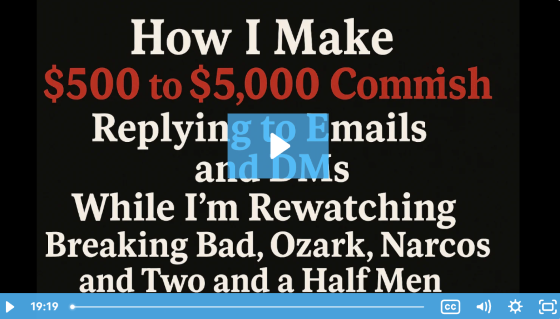
So the money sits there. You become the person who follows up. A real, personal message to someone who already raised a hand. Not a pitch, a conversation. That one-on-one follow-up is the thing almost nobody does, and it’s worth 25% to 50% of every sale you bring back. On offers that run $500 to $5,000, that’s a serious income from work you can do from the sofa, by email and DM, with no calls.
The Rainmaker
When you want more than a trickle, you run a Rainmaker. It takes a partner’s quiet, warm list and turns it into a short, sharp wave of sales. It pairs a simple email sequence with the same personal follow-up, so a marketer with no product, list, or ad budget can produce a flood of revenue in a compressed window and split it with the partner.
It works because warm beats cold every time, and because most owners never run a real campaign to the people they already have. You bring the campaign. They bring the audience. Nobody risks anything upfront.
The Phoneless Sales Machine
The single biggest thing that stops people from selling is the call. The pitch. The moment you have to get on the phone and push. So they never start.
The Phoneless Sales Machine, or PSM, takes the phone out of it entirely. The buyer reads something simple, gets a few personal messages from a real human, and decides on their own. People buy high-ticket offers through writing every day. If the idea of a sales call makes you wince, this is the play that means you never make one.
The Fun Auction
Most launches drag. Weeks of build-up, a long open cart, a slow leak of interest that never converts. A Fun Auction does the opposite. It compresses everything into a short, playful 24-hour window where people either raise their hand now or miss it.
The magic is in the tone. It doesn’t feel like being sold. It feels like a game with a clock, and that lightness is exactly why response shows up. It’s a fast way to book a wave of partner calls or sales without the pressure, or the dead air, of a normal launch.
Licensing and digital vending machines
This is where it stops being about one campaign and starts being about streams. A partner has content sitting idle: an old course, a webinar, a book, a vault of posts. You repackage it into something sellable and place it in front of an audience that already trusts the person who made it. Travis calls the result a digital vending machine. It collects money, royalties, and commissions without you owning the product or the traffic.
Licensing takes the same idea further. You rent permission to use someone’s intellectual property in a new market, on a new platform, or in a new niche. Each permission is another royalty stream. The course owner keeps making what they already make, and you collect on every sale you open up, from a deal you only structured once.
Picture a normal evening
It’s a Tuesday. You’ve just put something on to watch. Your phone buzzes with a reply from someone who went to a partner’s workshop last week and left without buying. They’re not angry, they just had a question about whether it would work for their situation. You answer like a human, the way you would help a friend, and you let them sit with it. No push. You send two more short follow-ups to other people who went quiet, then settle back into the episode.
Before the credits roll, one of them says yes. The offer was $2,000, the buyer checks out through the owner, and your 40% share, $800, is earned for a conversation you had between scenes. The owner collects, then your cut follows. You did it from the sofa, for a partner you actually like, with no call, no boss, and no product of your own.
That’s not a fantasy version. That’s a slow Tuesday. There’s a Ronin in Finland working $25,000 offers at 20%, which is $5,000 a sale. Others collect licensing royalties from courses they didn’t create, on every sale the rights holder makes, money that shows up while they sleep. Different plays, same shape: income from assets you don’t own. Travis calls this Marilyn Monroe money — income you collect rather than grind for.
The reason this is worth picturing is that it reframes what the work actually is. You’re not grinding. You’re not cold-calling strangers. You’re having a handful of genuinely helpful conversations with people who already raised a hand, and getting paid a real share when you help them get what they came for.
The craft that makes every play work
Notice what all five plays have in common. None of them need cold outreach, a product, or an ad budget. What they do need is the ability to make warm people feel something and say yes. That’s copy, and the way Travis teaches it isn’t the way most people write.
It starts with desire, and desire comes from contrast. The Hell Island vs Heaven Island framework is the backbone: show the reader the painful place they’re stuck now, the better place on the far shore, and a believable boat across. Describe only the dream and it reads like hype. Sit them in the pain they’re already living first, and the payoff lands.
Then there’s the order you say things in. The 5 Ps of copy, Pain, Plan, Personality, Philosophy, and Price, are the five things you presell before you ever pitch. The Plan is the meat, because if someone buys your plan, they buy your product. Which is really the whole point of preselling: warm someone up so completely that, by the time the offer arrives, buying feels like the obvious next step rather than a decision.
Two smaller tools do an outsized amount of work. A symptomatic subject line names the thing the reader actually feels, not the clinical problem behind it, so the email gets opened instead of scrolled past. And the Triangle of Insight connects two things the reader already knows to spark a third they’ve never realized, the little jolt of “I never thought of it that way” that makes a message land and stick.
I’m not going to teach you the mechanics of any of these here. That would be a disservice, because reading about a frame and being able to make it fire on a real stranger are two very different things. What you should take from this section is simpler: the plays aren’t magic. They run on a specific, learnable craft, and that craft is the thing worth getting good at.
Why a partner ever says yes
A fair question hangs over all of this: if there’s money sitting in their list, why would a business owner let you walk in and take a share of it? Why not do it themselves?
The honest answer is that they won’t do it themselves, and they know it. They’ve tried. The follow-up always loses to the next launch, the next piece of content, the next fire. Working old leads one by one is slow, unglamorous, and easy to put off forever. It’s the single most neglected job in almost every online business, precisely because the owner is busy doing the things only they can do.
Then there’s the risk. You’re not asking them for money. You’re not asking for a retainer, a fee, or a budget. You’re asking for a share of revenue that doesn’t exist yet and won’t exist unless you create it. If you produce nothing, they pay nothing and they’ve lost nothing but a little time. If you produce sales, they get the larger share of money they’d already given up on. There’s no version of that where they come out behind.
The framing that opens the door is the itty bitty test — a tiny first campaign so low-risk they say yes without thinking. And you approach it as the chooser, not the chaser: you’re deciding whether their asset is worth your time, not auditioning for their approval.
That’s the quiet genius of the whole model. You lead with how you take on the risk, not how they do. It’s why a deal is so much easier to land than a client, and why “yes” is the natural answer when you frame it properly. The partner isn’t doing you a favor. You’re doing them one, and getting paid out of the upside you create.
The horizon: owning the asset yourself
Everything so far is about collecting from assets other people own. There’s a level past that, and it’s worth seeing even on day one, because it changes how you think about all of it.
At some point you stop borrowing the asset and start owning it. Travis teaches this as the Shogun level, formerly Ownership Income, and the surprising part is how little money it takes to get there. The ideal target is a newsletter, community, or email list whose owner is leaving money on the table. The owner sees one revenue stream. You see the six they never switched on.
The price is rarely the obstacle people assume. Sometimes the seller finances the deal themselves, paid out of what the asset earns over time. Sometimes you option the asset, run sponsors or a campaign during a short test window, and let the asset pay for its own purchase price before you’ve spent a dollar. The cash isn’t the bottleneck. Creativity, courage, and a bit of collaboration are.
And you don’t have to run the thing day to day. Travis compares it to owning an NFL team. The owner doesn’t suit up on Sunday. They bring in people to run the day-to-day, and their job is to own the asset, switch on the revenue streams the last owner ignored, and collect. Your IP gets licensed out. Your audience becomes the traffic other businesses pay to reach. Your name is on the routing number on the 15th of the month.
What makes ownership pay is that one asset is never one income stream. The previous owner saw the obvious one, usually a subscription or the occasional product sale, and stopped there. The same asset can carry several streams at once: sponsorships and ads sold to businesses that would pay to reach the audience, contributors who sell to the room while you take a cut, licensing the IP into new markets, spinning a niche-within-the-niche into its own smaller property, brokering introductions between members who need each other. None of those require you to do the heavy lifting once the structure is set. That’s the difference between owning the building and renting one room in it.
You don’t need to know how to build any of that today. You need to see that it exists, because it changes the meaning of the early work. Every warm follow-up you send for a partner is teaching you the exact skills, reading people, structuring deals, running campaigns, that you’ll one day point at an asset with your own name on the deed.
That’s the ladder. Start by following up on warm leads for a share of the sale. Learn the craft. Run bigger campaigns. Then, when you’re ready, stop renting other people’s assets and start owning your own. Same skills, applied one rung higher each time.
Who this is actually for
I’ll be straight with you, the way I’d want someone to be with me.
This is the most beginner-friendly money skill I know of online, and it’s still a skill. You’re not building anything and you’re not spending anything, which removes the two things that sink most beginners. But you do have to learn how to run a good follow-up, and you do have to actually send the messages. Nobody hands you money for nothing.
What makes it beginner-friendly is the risk profile. You put in no money upfront. The partner risks nothing, because they only pay you out of sales you produce. You’re talking to warm people who already raised a hand, not strangers who owe you nothing. You don’t need to sell in the traditional sense, and you don’t need a website or funnel to run the first campaign. And you’re paid for results, which means nobody gets to boss you around.
It fits a particular kind of person. Someone who would rather partner than chase. Someone who likes the idea of leverage and systems more than grind. Someone who’s fine being genuinely helpful and genuinely okay with a no. If that’s you, the rest is learnable.
You don’t do this alone
Here’s the part that matters most, and the part a page like this usually leaves out.
When I say “we see the six revenue streams they never switched on,” I mean a real we. The plays above are taught inside Royalty Ronin, Travis Sago’s group, and the training is good. But the training isn’t the reason to be there. The room is. There are 500+ deal makers inside who share leads, partner on campaigns, spot opportunities for each other, and pool what’s working so nobody has to reinvent the wheel alone.
That changes the whole experience of starting. You’re not a beginner staring at a blank page, hoping you understood the framework. You’re someone with 500+ people who’ve been exactly where you are and will work with you, not just cheer you on. Ronin partner with other Ronin. That’s how the deals get found, and that’s how the hard early weeks get survived.
Travis is in there every day. He’s not a cheerleader, and I won’t pretend otherwise. You bring your own motivation. But if you’ll bring that, you’re walking into a room built entirely around the idea that you should serve no master, and full of people proving it works.
Where to start
If you read all of this and felt something click, that’s the symptom worth paying attention to. You don’t need a product. You don’t need an audience. You don’t need an ad budget. You need warm people who already raised a hand, a partner who has them, and the willingness to learn the craft of getting them to yes.
Royalty Ronin is where that craft is taught, where you learn to find the right partners and build the deals. It’s $111 a month with a 7-day free trial, which is long enough to look around inside before you decide a thing. And the right deal can cover a whole year of living expenses, not just the membership.
When you’re ready to move:
- How to approach a course creator for a partnership
- How to write a JV proposal coaches say yes to
- What to do with unconverted leads that never bought
- Win-back campaigns: bringing expired members back to life
- Revenue share vs retainer: which pays marketers more
Start your free trial inside Royalty Ronin →
And if you’re not ready for that yet, get on my list. You’ll get the free Found Money Starter Guide, then plain-English breakdowns of these plays in pieces you can use whether you ever join or not. Get them on my list →
FAQ
Do you need to own an email list or audience to make money from it?
No. The whole model is borrowing assets other people built. You partner with someone who already has the list, product, or community, do the follow-up they skip, and take a share of the revenue you produce.
What are the main plays in the Dormant Asset Playbook?
Warm follow-up, the Rainmaker, the Phoneless Sales Machine, the Fun Auction, and licensing or digital vending machines. They ladder from your first warm-lead follow-up all the way up to the Shogun level, where you own the asset.
Keep reading
Sources: Royalty Ronin (Travis Sago) on Skool